

Have you ever said: "I know exactly why I do this. I just can't seem to stop."
You know you're a people-pleaser. Trusting people doesn't come easily, and you can tell exactly when it's happening. Criticism makes you defensive. You've noticed. You've traced how your childhood shaped your relationships.
Boundaries? You should be setting them.
And that text? You definitely shouldn't send it. And yet. There you are. Sending the text. Again.
This is one of the most frustrating parts of personal growth. You can understand yourself incredibly well, have all the insight in the world, and still find yourself repeating the same patterns.
Which raises a very reasonable question: If I know why I'm doing something, why can't I just stop?
Here's the short answer. Insight changes what you understand. It doesn't automatically change what your body and nervous system have learned to do. Patterns don't only live in your thinking mind. They live in your habits, your relationships, and your body. And changing them usually takes new experiences, not just new information.
Why Insight Alone Isn't Enough to Change a Pattern
I work with many people who have already done a tremendous amount of personal work.
They've been to therapy. Read the books. Listened to the podcasts. They can name their triggers without missing a beat. Attachment patterns? They've got those mapped, too.
Ask how their childhood contributed to the problems they're having today, and they'll walk you through it step by step. Some of them could probably teach a class on it.
But they're still struggling.
And here's why that makes sense. Insight is important, but insight alone doesn't always change deeply learned responses. Knowing something intellectually and experiencing it differently are not the same thing.
You can know that your partner loves you and still feel terrified when they're upset. You can be completely capable and still feel like a failure the moment someone criticizes you. And you can fully believe you're allowed to say no while still feeling enormous anxiety when you disappoint someone.
Your conscious understanding may have changed. But the emotional pattern can remain.
I learned this in my own healing, too. Insight alone didn't create change for me. It's a big part of why my individual coaching goes beyond talking about the pattern and into actually practicing something new.
Why Do I Keep Repeating the Same Patterns? Your Brain Loves What It Knows
Think about how many things you do automatically. You don't consciously think about every movement involved in brushing your teeth. You don't need to relearn how to drive every time you get in the car.
Repeated experiences create learned patterns that become increasingly automatic. Emotional and relational responses can become automatic, too.
Maybe you learned early in life that conflict meant danger. So now, when someone becomes upset, you immediately try to make things better.
Maybe you learned that asking for help led to disappointment. So now you handle everything yourself.
Maybe you learned that criticism meant you weren't good enough. So now even gentle feedback feels threatening.
These responses made sense in the environments where they developed. They were smart. They were protective. They helped you get through.
But what helped you adapt at one point in your life may be creating problems today.
And simply understanding that doesn't make the response disappear.
Your Body May Still Be Responding to an Old Story
This is where somatic coaching and nervous system regulation become valuable.
Let's say someone criticizes you. Intellectually, you know feedback isn't necessarily rejection. But…
Your stomach drops.
Your chest tightens.
Your face gets hot.
You feel an immediate need to defend yourself.
Before you've even considered whether the feedback is accurate, your body is already reacting.
You might tell yourself:
Don't be defensive.
This isn't a big deal.
Calm down.
But those instructions don't always change what's happening physiologically. Your nervous system may have learned to associate certain experiences with threat, and it responds to that old story faster than your thinking mind can step in.
That's not a failure of insight or effort. That's the body.
Somatic awareness helps you recognize those physical responses as they're happening. Regulation practices, like breathwork, help create enough space to respond differently. And deeper exploration helps you understand what the situation represents to you.
The goal isn't to replace thinking with body-based work.
It's to recognize that lasting change may require more than one kind of learning.
Sometimes We Understand the Problem but Keep Rehearsing It
Here's an example. Imagine you have a strong fear of abandonment. You've explored your childhood, and where the fear came from isn't a mystery anymore. Your partner isn't the person who originally hurt you. You're clear on that.
But every time your partner becomes distant, you panic. So you text. Then call. Ask what's wrong. Look for any sign of reassurance.
Eventually, your partner responds. Relief. But only for a moment.
What happened? You relieved the anxiety. But you may also have reinforced the idea that you cannot tolerate uncertainty without immediately seeking reassurance.
So the next time your partner becomes distant, the cycle begins again.
This doesn't mean reassurance is bad. Healthy relationships include reassurance. But if reassurance becomes the only way you can manage uncertainty, it may keep you from developing other ways of responding.
Understanding fear is one step. Learning to experience that fear without automatically repeating the same behavior is another.
How Do You Actually Change a Pattern You Already Understand?
It usually comes down to four steps, practiced over and over.
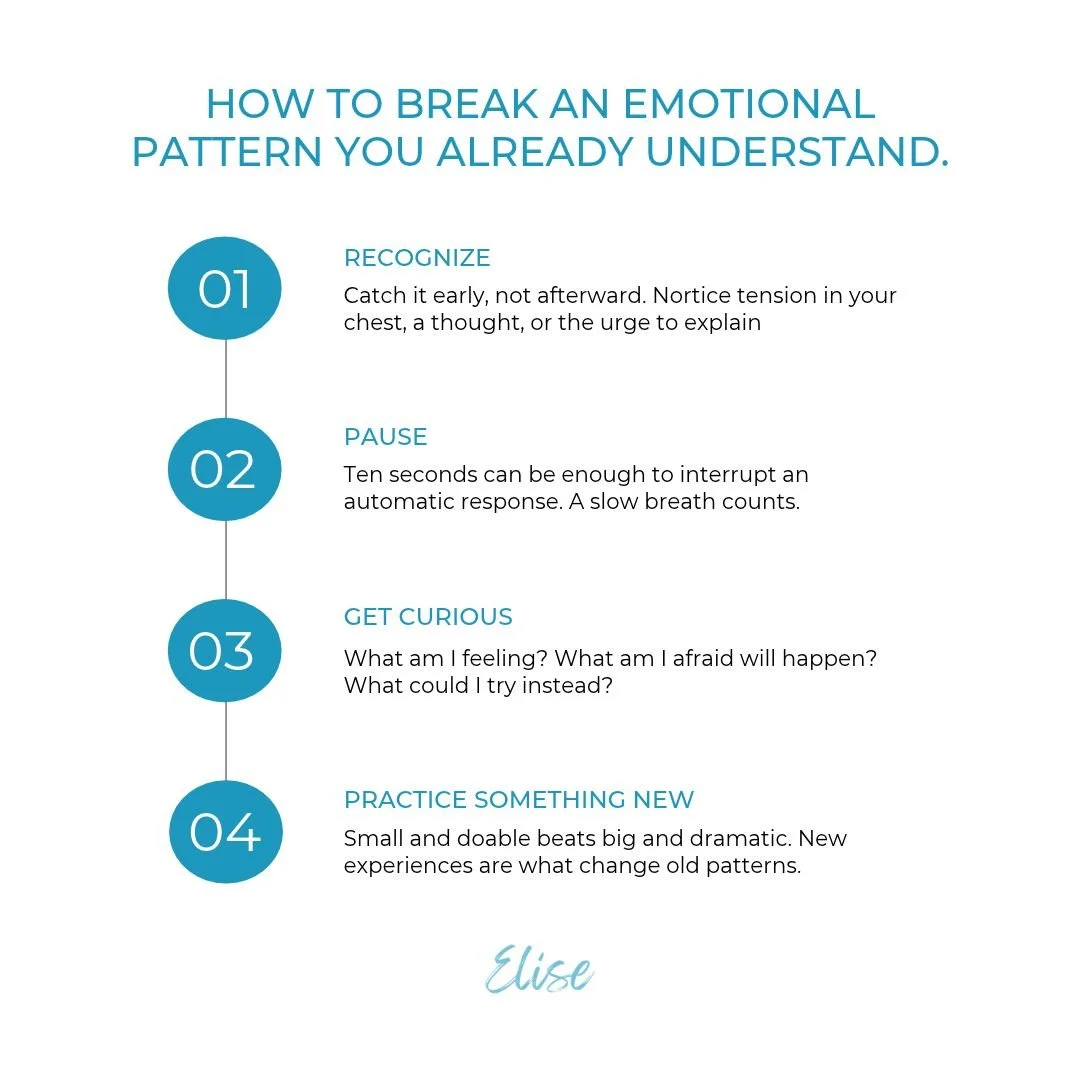
Recognize the pattern early. Not just afterward, when you're sitting on the couch wondering why you did it again. Learn the earliest signs. Maybe it's tension in your chest. Maybe it's a thought. Maybe it's an urge to explain yourself. Maybe it's the sudden need to make someone happy.
Pause. Not necessarily for ten minutes. Sometimes ten seconds is enough to begin interrupting an automatic response. A slow breath counts.
Get curious. Ask yourself: What am I feeling? What am I afraid will happen? What do I usually do next? What could I try instead?
Practice a different response. Small and doable beats big and dramatic.
What might that different response look like?
If you normally chase reassurance, perhaps you wait a little while and regulate your anxiety before deciding whether to reach out.
If you normally say yes immediately, perhaps you tell someone you'll get back to them.
If you normally become defensive, perhaps you ask a question before explaining yourself.
If you normally shut down, perhaps you practice saying, "I'm overwhelmed, but I want to come back to this conversation."
These may sound like small changes. They're not. Because you're creating a new experience. And new experiences are an important part of changing old patterns.
Why Does Change Feel Uncomfortable at First?
This is something I wish more people understood. We assume that when we're making healthier choices, we should immediately feel better. Not necessarily.
Sometimes the healthier choice feels terrible. Setting a boundary may create guilt. Not seeking immediate reassurance may create anxiety. Being vulnerable may feel frightening. Allowing someone to be disappointed may feel almost unbearable.
That's because you're doing something unfamiliar. And unfamiliar doesn't always feel safe.
Of course, discomfort alone doesn't prove that a choice is healthy. We still need to consider the situation, our actual needs, and whether the relationship is safe.
But when an old pattern has been protecting you for years, changing it can feel uncomfortable even when the new behavior is exactly right.
That's where practice, support, and self-awareness become so important. You don't have to white-knuckle your way through it alone.
From Understanding Your Life to Changing It
Don't get me wrong. Insight matters. Understanding ourselves can be incredibly powerful, and sometimes one question helps us see something we've never recognized before.
But I don't want people to spend the rest of their lives simply becoming better at explaining why they're unhappy.
I want them to experience something different. To stop repeating the same arguments and abandoning themselves. To quit letting old fears make present-day decisions. To build relationships that actually feel different, and a life that isn't organized around problems that began decades ago.
Insight helps us understand the story. Change happens when we begin living differently.
And that takes practice.
So Here's My Question for You
What's something you understand about yourself intellectually but continue doing anyway?
Don't start by judging yourself.
Start by getting curious.
What is the old behavior doing for you, and what would you need to learn or experience to do something different?
Because understanding why you're stuck is valuable.
But you don't have to stay there.
If you're tired of explaining your patterns and ready to start living differently, I'd love to talk. You don't have to keep carrying this on your own. Reach out, and let's start there.
Frequently Asked Questions
Why do I keep repeating the same patterns even when I know they're unhealthy?
Because knowing and responding run on different kinds of learning. Patterns that formed through years of repetition become automatic, so they can fire before your conscious understanding catches up. Insight explains why the pattern exists. Changing it usually takes practicing a new response, many times, until it starts to feel familiar.
Why isn't self-awareness enough to change my behavior?
Self-awareness helps you recognize a pattern, but it doesn't rewire the emotional response underneath it. Lasting change usually comes from noticing the pattern early, regulating your body enough to pause, and practicing a different choice in real situations. Over time, those new experiences teach your system that a different response is safe.
What does my nervous system have to do with emotional patterns?
Your nervous system learns from experience which situations feel safe and which feel threatening. If criticism or conflict once meant danger, your body may still tense, brace, or rush to fix things before you've had a chance to think. Regulation practices create enough space between the trigger and your response to choose differently.
Can somatic coaching help me break patterns I already understand?
Yes. Somatic coaching is often a good fit for people who understand their patterns intellectually but still feel stuck. It works with body sensations, breath, and nervous system responses alongside coaching, so change happens where the pattern is actually running, not only in your thinking. It is coaching, not therapy or medical treatment.
How do I stop chasing reassurance in my relationship?
Start by noticing the earliest signs, like tightness in your chest or the urge to text again. Pause, even for ten seconds, and ask what you're afraid will happen. Then try one small, different response, like waiting and regulating before you reach out. Repeating that new experience is what slowly loosens the old pattern.
Why does making a healthier choice feel so uncomfortable?
Healthier choices often feel uncomfortable because they're unfamiliar, and unfamiliar doesn't register as safe right away. Setting a boundary can bring guilt. Not seeking reassurance can bring anxiety. That discomfort doesn't automatically mean you're doing something wrong. It often means you're interrupting a pattern that has been protecting you for years.
How long does it take to change an emotional pattern?
There's no universal timeline. It depends on how long the pattern has been reinforced, what support you have, and how often you get to practice a new response. Most people notice change gradually: a little more space before reacting, a faster recovery afterward. Progress is usually uneven, and that's completely normal.
Is coaching right for me if I've already done therapy and still feel stuck?
It can be. Many of my clients have already done therapy, read the books, and understand their patterns, yet still feel stuck. My work blends coaching, somatic work, and breathwork for exactly that place, where the insight is there but lasting change hasn't followed. If that sounds like you, I'd love to hear from you.
This blog is for informational purposes only and does not constitute medical, psychological, or therapeutic advice. Nothing here is intended to diagnose, treat, cure, or prevent any mental or medical condition. Coaching is not a substitute for therapy or medical care. You are responsible for your own physical, mental, and emotional well-being, decisions, and actions. If you're in crisis or need immediate support, please contact a licensed professional or emergency services.
