
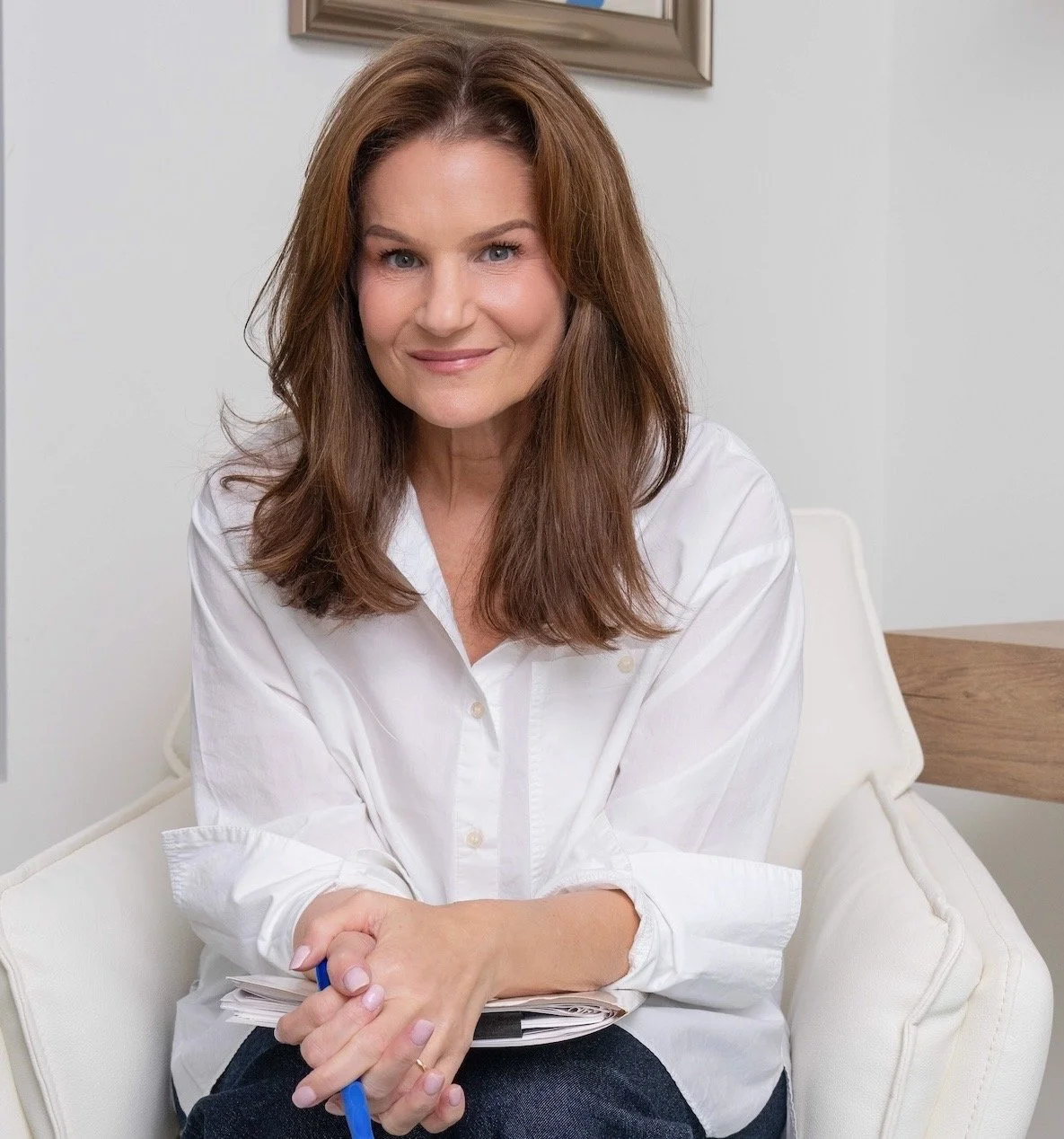
I know it's been a while. So let me reintroduce myself.
If you've been on this list for a long time, there's a good chance you first knew me as a blonde who talked a lot about parenting. A few things have changed. The hair, obviously. But more importantly, the work has evolved. Today, my coaching centers on nervous system regulation, somatic work, and the deeper patterns that keep self-aware people stuck in the same cycles, whether that shows up in parenting, in a marriage, or in the quiet feeling that something is still "off."
Here's how I got here, and what this work actually looks like now.
If You Knew Me as "The Parenting Coach," Here's What Changed
Many of you originally found me through parent coaching, and I still work with parents today. I love that work. So much of what I understand about people, relationships, emotional regulation, and behavior grew out of the years I spent helping parents understand what was really happening beneath their child's behavior.
Because behavior is rarely just behavior.
And, as it turns out, that's not only true for kids.
Over the years, the conversations with my clients began to change. Parents started talking about their marriages. People began coming to me individually. And instead of only asking, "How do I change this behavior?" we started asking much bigger questions…
Why does this bother me so much?
Why do I keep choosing the same kind of relationship?
Why do I know exactly what I should do, but still can't seem to do it?
Why does my body react before my brain has even had a chance to catch up?
Why am I still struggling with something I thought I dealt with years ago?
Those questions changed the direction of my work. Today, I work with individuals, couples, and parents, with a much deeper focus on trauma, early experiences, relationship patterns, somatic work, and nervous system regulation. I'm also completing my master's degree in Marriage and Family Therapy, which has given me even more ways to understand people, relationships, and how lasting change happens.
But the thing that probably separates my work the most hasn't changed. I ask a lot of questions. Not just questions about what happened. I want to know what it meant to you. What did you feel? What did you need? What did you learn about yourself in that moment? What did you have to become to feel safe, loved, accepted, or enough? And are you still living by those rules today?
One of the things I hear most often from clients is: "I've been to so many therapists, and no one has ever asked me questions like this before." I love hearing that, not because I believe there's one right way to do this work. There isn't. Different people need different approaches at different times. But I am incredibly curious about what's underneath the problem.
Why Doesn't Knowing Better Make It Easier to Do Better?
You can be extremely self-aware and still find yourself repeating the same patterns.
You can know you're a people-pleaser and still feel panicked when someone is disappointed in you. You can understand that your partner isn't your ex and still feel your entire body react when they pull away. You can promise yourself you're going to stay calm with your child and then hear yourself yelling five minutes later. You can know intellectually that you're safe and still feel anxious.
Why?
Because change doesn't happen only through insight. Our early experiences don't just become memories. They can shape the beliefs we form, the relationships we create, the way we respond to stress, and what our nervous system learns to interpret as safe or threatening. Sometimes your mind has moved on long before the rest of you has.
That's one reason nervous system regulation coaching and somatic work have become such an important part of what I do.
What Is Nervous System Regulation, Really?
"Nervous system regulation" has become one of those phrases we see everywhere. But it doesn't simply mean being calm all the time.

A regulated nervous system can experience stress, anger, sadness, fear, excitement, and conflict without becoming completely overwhelmed or shutting down. The goal isn't to eliminate uncomfortable emotions. The goal is to increase our capacity to experience them without automatically falling into the same old survival responses.
That may involve learning how to recognize what's happening in your body before you're completely activated. It may include grounding, breathwork, slowing down, movement, or other somatic techniques. But regulation is only part of the work, because I don't just want to help you calm your nervous system after you've been triggered for the four-hundredth time. I want us to get curious about why this particular thing has so much power over you in the first place. That's where things get interesting.
What Is Somatic Coaching and How Does It Fit In?
"Somatic" simply means relating to the body. Somatic coaching pays attention not only to thoughts and emotions, but to what's happening physically: tension, breath, sensation, impulse, and other bodily responses that talk therapy or traditional coaching alone can miss.
This is often the missing piece for people who already understand their patterns intellectually but still feel a powerful, automatic response take over in the moment. If you've ever thought, "I know exactly why I do this, so why can't I just stop?", then somatic work is usually where the answer lives.
Maybe You've Already "Gotten Better." But Are You Thriving?
Maybe you've been to therapy before. Maybe you understand your childhood. Maybe you've learned coping skills. Maybe your anxiety is better than it used to be, your relationship is more stable, you're functioning, you're successful, you're getting through your days.
That's all meaningful. But I want to ask you something else: are you thriving?
Do you actually like the life you've created?
Do you like yourself inside of it?
Can you say what you need without immediately worrying about how everyone else feels?
Can you tolerate someone being disappointed in you?
Can you have conflict without feeling like the relationship is in danger?
Can you receive love without questioning it?
Can you rest without feeling guilty?
Can you recognize when an old wound is driving a present-day reaction?
Can you make choices based on what you want rather than what you're afraid of?
Those are the questions I'm interested in now, because I don't think the goal is simply to become less miserable. I don't want my clients to just get by. I want them to understand the old patterns that are still running their lives, heal what needs healing, and create something different: a different relationship with themselves, different relationships with the people they love, different choices, different possibilities. Maybe even a completely different life.
And yes, sometimes that starts with something as simple as learning how to breathe differently when your nervous system is screaming that you're not safe. Other times it starts with one question you've never been asked before.
What We'll Be Talking About Here
Parenting. Relationships. Trauma. Nervous system regulation. Breathwork. Somatic work. Emotional triggers. People-pleasing. Childhood patterns. And the strange things we humans do even when we know better.
If any of this resonates and you want to go deeper one-on-one, that's exactly the work I do in individual and couples coaching. And if parenting is still where you're feeling stuck, parent coaching is still very much alive and well. It's just gotten a lot more curious about what's underneath the behavior, for you and for your child.
I'm excited to be writing to you again! And for those of you who've been here since the blonde days, thanks for sticking around. We've got a lot to talk about.
Frequently Asked Questions
Do you still offer parent coaching?
Yes, parent coaching is still an important part of my work. My approach looks beyond simply stopping an unwanted behavior and explores what's driving it, the parent-child dynamic surrounding it, and how parents can respond in ways that create meaningful, sustainable change.
What is nervous system regulation coaching?
Nervous system regulation coaching helps you move through stress, emotion, and activation and return to a state where you can think, connect, and respond flexibly. It uses tools like breathwork, grounding, and movement, and the goal isn't constant calm. It's greater capacity to feel difficult emotions without being controlled by them.
What is somatic coaching, and how is it different from talk therapy?
Somatic coaching works with the body, not just the mind, including tension, breath, sensation, and automatic physical responses, as a doorway into change. It's often most helpful when someone already understands a pattern intellectually but still has a strong automatic reaction in their body.
How much does coaching cost, and how long are sessions?
Sessions are $250 per hour across individual, couples, parent, and somatic coaching. There's no package or minimum commitment. Some clients come for a handful of sessions around one specific issue, and others stay for ongoing support.
Are you a therapist?
I'm currently completing my master's degree in Marriage and Family Therapy, but my current work is coaching, not therapy. I work with individuals, couples, and parents within that scope, and I'll always be transparent about my role, credentials, and the services I provide as that continues to evolve.
Who is this kind of coaching actually for?
It's for adults, couples, and parents who want to understand themselves and their relationships on a deeper level, including people who are already highly self-aware. Many clients understand what they do but still don't understand why they keep doing it, or how to finally change it.
I've already done therapy and coping skills before. Will this feel repetitive?
Probably not. This work goes past managing symptoms into asking why a pattern still has so much power over you, using nervous system and somatic tools alongside coaching conversation. Clients who've "already gotten better" often find this is where things finally start to shift.
How do I get started?
Reach out through the contact form on the website, and I'll respond personally. The first session is a low-pressure introduction, with no expectation that you'll have things "figured out" before we begin.
This blog is for informational purposes only and does not constitute medical, psychological, or therapeutic advice. Nothing here is intended to diagnose, treat, cure, or prevent any mental or medical condition. Coaching is not a substitute for therapy or medical care. You are responsible for your own physical, mental, and emotional well-being, decisions, and actions. If you're in crisis or need immediate support, please contact a licensed professional or emergency services.
